Global Migration Network (GMN)
The EB‑2 National Interest Waiver (NIW) is a U.S. employment-based immigrant visa category that offers a pathway to permanent residency for individuals who hold advanced degrees or possess exceptional ability in the sciences, engineering, arts, or business.
Unlike traditional EB‑2 petitions that require a specific job offer and labor certification, the NIW enables applicants to self-petition by demonstrating that their work will substantially benefit the United States. According to the U.S. Citizenship and Immigration Services (USCIS), applicants must prove that their proposed endeavor has both substantial merit and national importance, that they are well-positioned to advance this work, and that waiving the job offer requirement would be in the national interest.
This visa is particularly valuable for professionals whose innovative contributions can drive advancements in key areas such as technology, healthcare, and economic development, ultimately strengthening U.S. competitiveness and public welfare. This pathway is particularly attractive for global expertise and other professionals who have a proven record of excellence and a clear vision for contributing to the national interests of the United States.


Before considering the NIW, an applicant must first qualify under the broader EB‑2 category. There are two main paths within this category:
Advanced Degree
• Applicants must possess an advanced degree, which is any degree beyond a bachelor’s degree. This typically includes a master’s, Ph.D., MD, or equivalent.
• Alternative Path: If an applicant holds only a bachelor’s degree, they must have at least five years of progressive, post-bachelor’s work experience in their field. This combination is considered equivalent to an advanced degree.
Exceptional Ability for EB-2 NIW
For applicants who do not meet the advanced degree criteria, demonstrating exceptional ability in the sciences, arts, or business is an alternative route. This means having a degree of expertise significantly above that normally encountered in the field.
• Evidence: Proof of exceptional ability can include:
• Awards or recognitions that signify industry acclaim.
• Membership in professional associations requires outstanding achievement.
• Documentation of significant contributions, such as published work, patents, or high-level positions.
• Letters from experts attesting to the applicant’s superior skills and accomplishments.
• Official academic records (degrees, diplomas, or certificates).
• Documentation of at least 10 years of full-time experience in your field.
• Licensure or professional certification.
• Evidence of high remuneration that underscores your advanced skill level.
• Membership in recognized professional associations.
• Peer or industry recognition for significant contributions to your field.
B. National Interest Waiver Specifics for EB-2 NIW
Beyond the basic EB‑2 requirements, the NIW focuses on your proposed endeavor’s potential to benefit the United States on a national scale. To qualify for the waiver, you must demonstrate that:
• Substantial Merit: Your work has a significant impact in critical areas such as healthcare, education, technology, or economic development.
• National Importance: Your project or professional contributions extend beyond benefiting a single employer—they are poised to create broad societal or economic benefits.
• Readiness and Feasibility: Your educational background, professional experience, and detailed project plan clearly show that you are well-equipped to advance your proposed endeavor.
• Net Benefit: The overall advantages of waiving the job offer and labor certification requirements outweigh the benefits of adhering to traditional employment-based processes.
To succeed with an NIW petition, your application must address three critical prongs:
Prong 1: Substantial Merit and National Importance
Overview:
Explain your proposed endeavor in detail and show how it delivers significant benefits at a national or regional level. This description should go beyond the general duties of your profession and highlight the unique impact of your work. The work should have implications that extend beyond a specific employer or geographic area. The focus is on a broader impact that benefits the nation as a whole.
How to Prove It:
• Offer specific examples (e.g., a breakthrough in medical research, innovative technological development, or an entrepreneurial project that stimulates economic growth).
• Support your claims with documentation such as project proposals, research summaries, or evidence of public benefit.
Prong 2: Well-Positioned to Advance Your Endeavor
Overview:
Demonstrate that you have the credentials, skills, and proven track record necessary to drive your proposed initiative forward. The applicant must provide evidence of being well-prepared to successfully advance the proposed project or initiative.
How to Prove It:
• Educational & Professional Background: Include transcripts, diplomas, and a detailed curriculum vitae (CV).
• Achievements: Provide evidence of significant professional contributions—such as awards, publications, patents, or notable projects.
• Detailed Plan: Present a clear, strategic proposal outlining your plan, milestones, and how you intend to realize your vision.
• Letters of Support: Secure testimonials from industry experts or organizations that can confirm your expertise and potential.
Prong 3: Benefits of Waiving the Job Offer and Labor Certification
Overview:
Convince USCIS that granting the NIW would be advantageous for the United States, even if a job offer is not available. This requires a comparative analysis that illustrates the benefits of your contributions against the conventional process.
How to Prove It:
• Unique Contributions: Explain why your specialized expertise or innovative ideas are not readily available in the U.S. workforce.
• Economic and Social Impact: Highlight potential benefits such as job creation, economic revitalization, or improvements in public health and national security.
• Impracticality of Labor Certification: Describe any challenges or impracticalities in obtaining a traditional job offer or labor certification due to your unique skills.

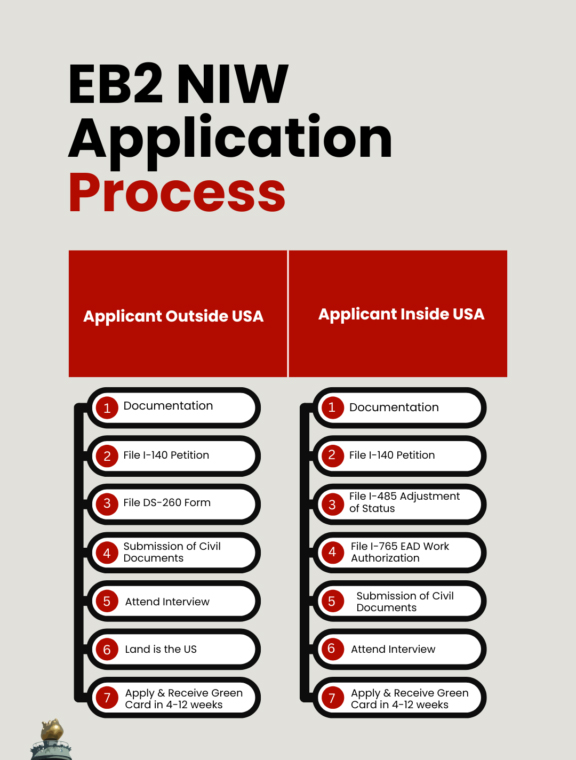
Processing times for an EB‑2 NIW petition can vary considerably based on several factors, including the service center handling your case, the complexity of your petition, and whether you are filing from within the United States or abroad. Below is a detailed discussion of the various stages in the EB‑2 NIW process and their typical processing timelines:
Processing Times
• General Timeline: EB‑2 NIW applications typically take between 11 to 14 months to process (time range changes). However, the time frame depends on the USCIS Service Center and the specific details of your case.
Factors Influencing Time:
• Service Center Workload: Different USCIS service centers may have varying workloads and efficiency, leading to differences in processing times.
• Complexity of the Case: A petition that includes extensive evidence or requires additional clarification may take longer to review.
• Case-by-Case Review: USCIS reviews each petition individually, and some cases may require additional documentation or an RF (Request for Evidence), which can extend the timeline.
• Sponsorship not Required:
Apply independently without the need for employer sponsorship.
• Waived Labor Certification:
Avoid the lengthy PERM process, reducing administrative burdens and speeding up your pathway to permanent residency.
• Current Visa vailability:
Approved applicants can apply for an immigrant visa or adjust their status without the typical waiting periods.
• Family Inclusion:
Your spouse and unmarried children under 21 can be included as derivative beneficiaries, obtaining permanent residency along with you.
• No Job Offer Required:
Unlike most employment-based visas that require a specific job offer from a U.S. employer, the EB‑2 NIW allows you to file the petition on your own behalf. This means you are not dependent on an employer to sponsor your green card.
• Increased Flexibility:
Without the need for employer sponsorship, you have greater control over your career and can pursue opportunities that align with your long-term goals, rather than being tied to a single employer.
• Time and Cost Savings:
By bypassing labor certification, you avoid both the lengthy and complex procedures typically associated with it, potentially reducing overall processing time and associated costs.
• Merit-Based Evaluation:
The NIW is granted based on the national importance and potential impact of your work rather than your employment status. USCIS considers how your proposed endeavor benefits the United States in areas such as technology, healthcare, education, or economic development.
• Broader Impact:
This visa category is ideal for individuals whose work has a wide-reaching impact, not limited to a single employer, but beneficial to the country as a whole.
• Streamlined Process:
With fewer requirements compared to other employment-based green card categories, the EB‑2 NIW can provide a more direct route to permanent residency. Once approved, you and your eligible family members (spouse and unmarried children under 21) can receive green cards.
• Potential for Concurrent Filing:
In certain cases, if the priority date is current, applicants may be able to file Form I‑140 (the immigrant petition) and Form I‑485 (adjustment of status) concurrently, which can accelerate the overall process.
• Long-Term Stability:
Obtaining a green card through the EB‑2 NIW provides long-term residency rights and the freedom to work for any employer or pursue self-employment, offering greater personal and professional flexibility.







Step | Action | Details |
Initial Consultation | Schedule Consultant Appointment | • Meet with an experienced immigration attorney or consultant. • Assess eligibility and determine if the EB‑2 NIW is the right pathway. |
Document Preparation | Gather and Organize Evidence | • Collect educational credentials (diplomas, transcripts, credential evaluations). • Compile proof of exceptional ability (awards, publications, patents, letters of recommendation). • Develop a detailed project or endeavor plan demonstrating national interest. |
Petition Filing | Submit Form I‑140 | • Complete and file Form I‑140 (Immigrant Petition for Alien Worker). • Include all supporting evidence that addresses both EB‑2 criteria and NIW-specific requirements. • Self-petition without the need for a job offer or labor certification. |
USCIS Review and Response | USCIS Evaluation | • USCIS reviews the petition and supporting documents. If additional information is needed, USCIS may issue a • Request for Evidence (RFE). Respond promptly and thoroughly to any RFE. |
I‑140 Approval | Receive Approval Notice | • Once the petition is approved, receive an approval notice from USCIS confirming eligibility under the EB‑2 NIW category. |
Adjustment of Status or Consular Processing | Proceed Based on Location | • Adjustment of Status: If residing in the U.S., file Form I‑485 to adjust status to permanent resident. • Consular Processing: If residing abroad, begin processing at a U.S. consulate or embassy once a visa number is available. |
Interview (if required) | Attend USCIS or Consulate Interview | • Some applicants may be required to attend an interview as part of the adjudication process. |
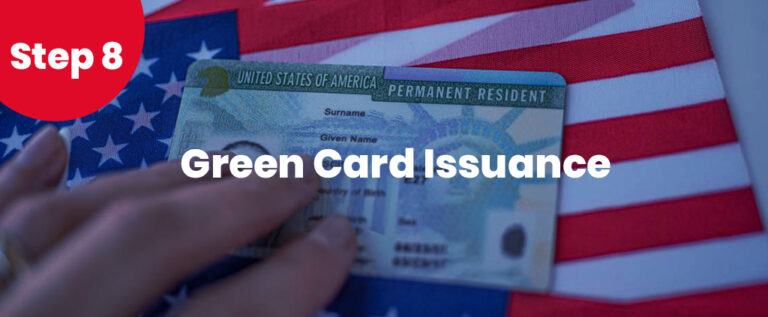
Green Card Issuance | Receive the Permanent Residency | • Upon final approval, obtain your U.S. Green Card (lawful permanent residency). • Eligible family members (spouse and children under 21) can also be included as derivatives. |
NIW allows you to self-petition without a job offer and bypass the labor certification process by demonstrating that your work benefits the national interest.
Yes. Even if you work in a private industry, you may qualify if you can prove that your work offers significant benefits to the United States.
While awards and honors can strengthen your case, they are not mandatory. What matters most is providing evidence of your accomplishments and the impact of your work.
The preparation timeline varies depending on your background. Gathering necessary documents may take anywhere from a few weeks to several months, especially if additional evidence of exceptional ability is required.
It refers to work or projects that have a positive impact in areas such as science, technology, business, health, education, or infrastructure. The broader and more significant the impact, the stronger your case.
No. One of the primary benefits of the NIW is that you do not need a job offer, as long as you can prove that your work is in the national interest.
A past denial for labor certification does not necessarily impact your NIW application if you meet the other qualifying criteria.
Depending on your qualifications, pursuing multiple avenues may improve your chances. However, consult with an immigration attorney to determine the best strategy for your circumstances.
Yes. You can apply from abroad. Exceptional achievements in your home country can also serve as evidence of your ability to contribute to the U.S.
It is possible, though challenging. Applicants in creative fields must clearly demonstrate how their work benefits the U.S. national interest.
It is generally better to tailor your recommendation letters to each visa category’s specific criteria.
Yes. To maintain your eligibility for permanent residency, you should continue working in the field that supported your NIW petition.